
Master Tutorial to Make Windows 8 / 8.1 Super Fast
UPDATE: This tutorial will also work for Windows 8.1.
Finally the wait is over. Many AskVG readers who have started using Microsoft’s latest OS Windows 8 were requesting us since long time to post our exclusive master tutorial to make Windows 8 super fast just like we posted similar tutorials for previous Windows versions in past. You can find them at following links:
- Master Tutorial to Make Windows 7 Super Fast
- Master Tutorial to Make Windows Vista Super Fast
- Master Tutorial to Make Windows XP Super Fast
This exclusive master tutorial series is one of our best and most popular articles and today in this article we are going to add another tutorial to this series.
Advertisement
Today we are going to share a detailed guide which will help you in making Windows 8 faster and improve your system performance. It’ll help you in disabling unnecessary eye candy effects such as shadows, animations, etc. Also you’ll be able to disable unwanted programs and services which start automatically with Windows.
So if you want to tweak Windows 8 and want to make it super fast, check out following simple steps:
Table of Contents
- STEP 1: Apply Registry Tweaks
- STEP 2: Customize System Properties to Disable Shadows and Animations
- STEP 3: Change Folder Options to Disable Unnecessary Features
- STEP 4: Disallow Unnecessary Windows Services to Start Automatically
- STEP 5: Disable Unnecessary Programs from Windows Startup
- STEP 6: Remove Sound Notifications of System Events
- STEP 7: A Few More Things to Do to Make Windows 8 Faster
STEP 1: Apply Registry Tweaks
We are providing a ready-made Registry script in this step which will tweak some settings in Windows 8 Registry to make Windows faster. It’ll reduce timeout values, set Windows to automatically end not responding tasks, make menus to show faster upon clicking and tweak various other settings.
Simply download the zip file given in following topic, extract it and you’ll get “Registry Tweaks to Make Windows Faster.reg” file. Run the file and it’ll ask for confirmation, accept it:
Download Windows 8 Registry Tweaks Collection
The zip file also contains an uninstallation registry script to restore all default settings.
STEP 2: Customize System Properties to Disable Shadows and Animations
By default Windows shows many eye candy effects such as animations, shadow effects, etc to enhance user interface. You can turn off these kind of effects to speed up system performance.
Advertisement
1. Press “Win+R” keys together to open RUN dialog box. Now type sysdm.cpl and press Enter. It’ll open System Properties window.
2. Now go to “Advanced” tab and click on “Settings” button present in “Performance” section.
3. It’ll open a new window. Now uncheck following options:
- Animate controls and elements inside windows
- Animate windows when minimizing and maximizing
- Animations in the taskbar
- Fade or slide menus into view
- Fade or slide ToolTips into view
- Fade out menu items after clicking
- Save taskbar thumbnail previews
- Show shadows under mouse pointer
- Show shadows under windows
- Show translucent selection rectangle
- Slide open combo boxes
- Smooth-scroll list boxes

4. Apply the changes and close the window.
PS: Mozilla Firefox and Microsoft Office users should also visit following tutorials to make these programs faster by disabling unnecessary animations and transition effects:
[Tip] Disable Smooth Typing Animation and Transitions to Make Microsoft Office Faster
[Tip] Make Mozilla Firefox Faster by Disabling UI Animations
STEP 3: Change Folder Options to Disable Unnecessary Features
You can disable a few features of Windows Explorer such as tooltips, etc to improve Explorer functionality:
1. Open My Computer and click on “View” tab present in the Ribbon. Now click on “Options” button present at the end to open Folder Options window.
2. Go to “View” tab and uncheck following options:
- Display file size information in folder tips
- Hide empty drives in the Computer folder
- Hide extensions for known file types
- Show encrypted or compressed NTFS files in color
- Show pop-up description for folder and desktop items
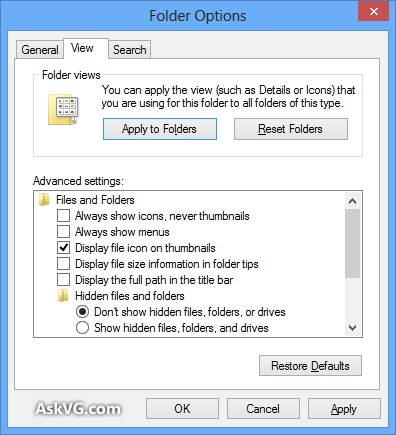
3. Apply changes and close the window.
STEP 4: Disallow Unnecessary Windows Services to Start Automatically
There are many built-in services in Windows which automatically start with Windows and always run in background even if the system doesn’t need them. You can disallow many unnecessary services to start automatically with Windows to improve system performance.
Check out following tutorial to learn which services you should disable in Windows 8:
[Guide] Which Windows 8/8.1 Services are Safe to Disable?
STEP 5: Disable Unnecessary Programs from Windows Startup
Many 3rd party software add their entries in Windows startup list so that they can automatically run as soon as Windows starts. Many of those startup items are unnecessary and can be removed from startup list to speedup Windows.
Follow these simple steps to disable unwanted startup items in Windows 8:
1. In previous Windows versions the startup items list was present in system configuration manager which can be accessed using msconfig command. But Microsoft has moved the startup items list in Windows 8. Now it can be accessed using Task Manager.
Right-click on Taskbar and select “Task Manager” option. Alternatively, you can directly open Task Manager by pressing “Ctrl+Shift+Esc” keys together.
2. Now go to “Startup” tab and here you can click on the unwanted item and click on “Disable” button to remove it from startup.

Now the disabled program will no longer run whenever you start Windows. It’ll only run if you launch it manually.
STEP 6: Remove Sound Notifications of System Events
By default Windows plays sounds for various system events such as error messages, device connect, device disconnect, command success, battery status, UAC prompt, etc.
Sometimes many of these sound notifications might cause a little bit slowness in your system. If you have a slow computer system, you can disable some or all sound notifications in Windows 8 to speedup your computer system:
1. Open Control Panel and click on Sound icon. Alternatively, you can directly open it using mmsys.cpl command.
2. Once you open Sound window, go to “Sounds” tab. Here you can click on desired program event which you want to disable and then select “(None)” from “Sounds” drop-down list.

If you want to disable all sound notifications, select “No Sounds” from “Sound Scheme” drop-down box.
3. Apply the changes and close the window.
STEP 7: A Few More Things to Do to Make Windows 8 Faster
After following all above mentioned steps, you should be able to notice big improvement in your system performance. Apart from these steps, you should also do following things regularly:
- Download and install latest updates using Windows Updates
- Use latest drivers for your computer hardware
- Install only necessary software
- Stay away from transformation packs! Install skins packs recommended by us only
- Use a good antivirus and keep it updated
That’s all for now. If you have any suggestion or query, feel free to share it in your comment…
Also Check:
sir, i have a problem with my laptop. when i used to open a computer tab then open search option but not search my files. Then another doubt that is ” click on to start button opened and search any files or apps but not show any options please solve my problem….
Are going to make a tutorial for Windows 10?
^^ Here you go:
https://www.askvg.com/master-tutorial-to-make-windows-10-super-fast/
Thanks a lot fo that awesome and effective Guide:)
It’s really helped me to get rid of slowing 😉
does not work for Windows 10………….do u have one file for it?
A really good one… Wow.. My 10 years old rig now runs fast.. Thank u soooooooo much….
Thank you so so much!
This is amazing! My system works so much better now!
Thank you again so so much for this! ^_^
i extracted it then i don’t know the next move. how can i perform the “win+R” … i just can’t do it -_-
How can I reverse what the registry editor did ? I cant see the bookmarks favicons in my google chrome anymore.
^^ The Registry tweaks have nothing to do with Google Chrome. It may be some other problem in your computer. Try to clear cache and cookies in your browser.
Regarding Registry script, there is another file included in the ZIP file to restore default settings in Registry.
thanks for sharing this great article. I will speed up my pc 10% faster with this guide
Hello brother,
I have suffered from my Win 8. It works slowly and using 99% of RAM even I DONT OPEN ANY PROGRAM. I even cannot doing multi tasking or even play solitaire or light pc games is laging. My laptop build with win 8, I want to downgrade to win XP or win 7 but it is hard, there are my setting I have to set up.
Any way thanks for the article, it helps me even the RAM still big in process but it little bit smooth now. If you have another way to reduce my big problem in using RAM, I will really thanks. 🙂
Thanks
Hamida
Hi,
After I applied the registry tweaks, my computer worked fine but now it is very fast, except that the browsers open but will not connect to any site. I don’t know how that would relate to the registry changes, but do you have any thoughts?
Matt
^^ The Registry tweak has nothing to do with your problem. Double-check the services list and enable any service which you disabled or set to Manual. Also try to temporary disable your antivirus.
Why can I not disable anything from task manager? Is it because I am not an administrator? In that case, how do I input the password?
^^ You can try CCleaner if you are having problems:
https://www.askvg.com/ccleaner-freeware-system-optimization-and-privacy-tool/
Thank you so much AVG for sharing this, but I have a question about the Registry tweak:
I have a win optimization app, which specifically is Ashampoo win optimizer, in one of its functions, there is a function call Registry optimize, I run this function whenever I have a full scan on my computer. May I ask if this function, like the same function in many optimizer programs, reverse the change I applied to the registry with your trick? If so, should I disable it?
Thank you
Sorry I’m quite amateur about this stuffs, but if my computer has multi accounts, should these registry tweaks be applied individually, since all of them are administrators.
^^ Here are the answers:
1. I never recommend using any Registry optimization software as these software can harm the Registry by deleting essential keys.
2. Some registry keys are user-specific. So you should apply the Registry script in all desired accounts.
Thank you for the answer, just one more thing, actually the function is more like Registry Cleaner, it lists out a lot of entries and prompt me to delete them, is it safe to delete these entries? My friend recommends using CCleaner as a popular windows optimization software, do you have any choice of your own?
@Eru
As I said earlier I never recommend Registry optimization software and Registry cleaner is a part of it. Dont delete Registry entries which you are not sure about.
VERY-VERY-VERY…….VERY GOOD.THANK YOU.
Please Do a Tutorial for gamers to increase fps in games (counter strike etc…..)
Thanks bro, my PC was struggling a bit while playing online videos, those Registry tweaks indeed made my system very fast, so thank you. However my system still lags a lot while steaming videos online on all websites. I tried everything, installing new antivirus, updating drivers, windows update patches, internet is fast but it still struggle while playing videos online & I didn’t experience this issue earlier ever. Can u plz help me about this??
My system stats:
Model: Gigabyte 945GCMX-S2
Processor: Inter(R) Core(TM) 2 CPU, 4400@ 2.00 GHz, 2.00 GHz
RAM: 2.50 GB
OS: Windows 8, 32-bit OS, x64-based processor
Thanks.
Nice tweaks for Windows in general. Thanks very much for this tip, it helped me a lot and improve my system perfomance.
Would seem to you have a power supply prob or memory
Noticed that if you turn off “Distributed Link Tracking Client” service, then OneDrive will not autostart.
Above steps mentioned are perfect for windows 8 users but apart from these steps you can also use some steps such as killing unwanted startup items, disable shadows and animations and the best way is you can also download some best available software which will work as a all in one features and help you to speed up windows PC.
Windows still doesn’t manage the page file very well in Windows 8.1 I like to set it manually and make the minimum the size of my current physical RAM and the maximum twice that. Seems to make it run programs better.
thank you so much askvg